Clients and servers
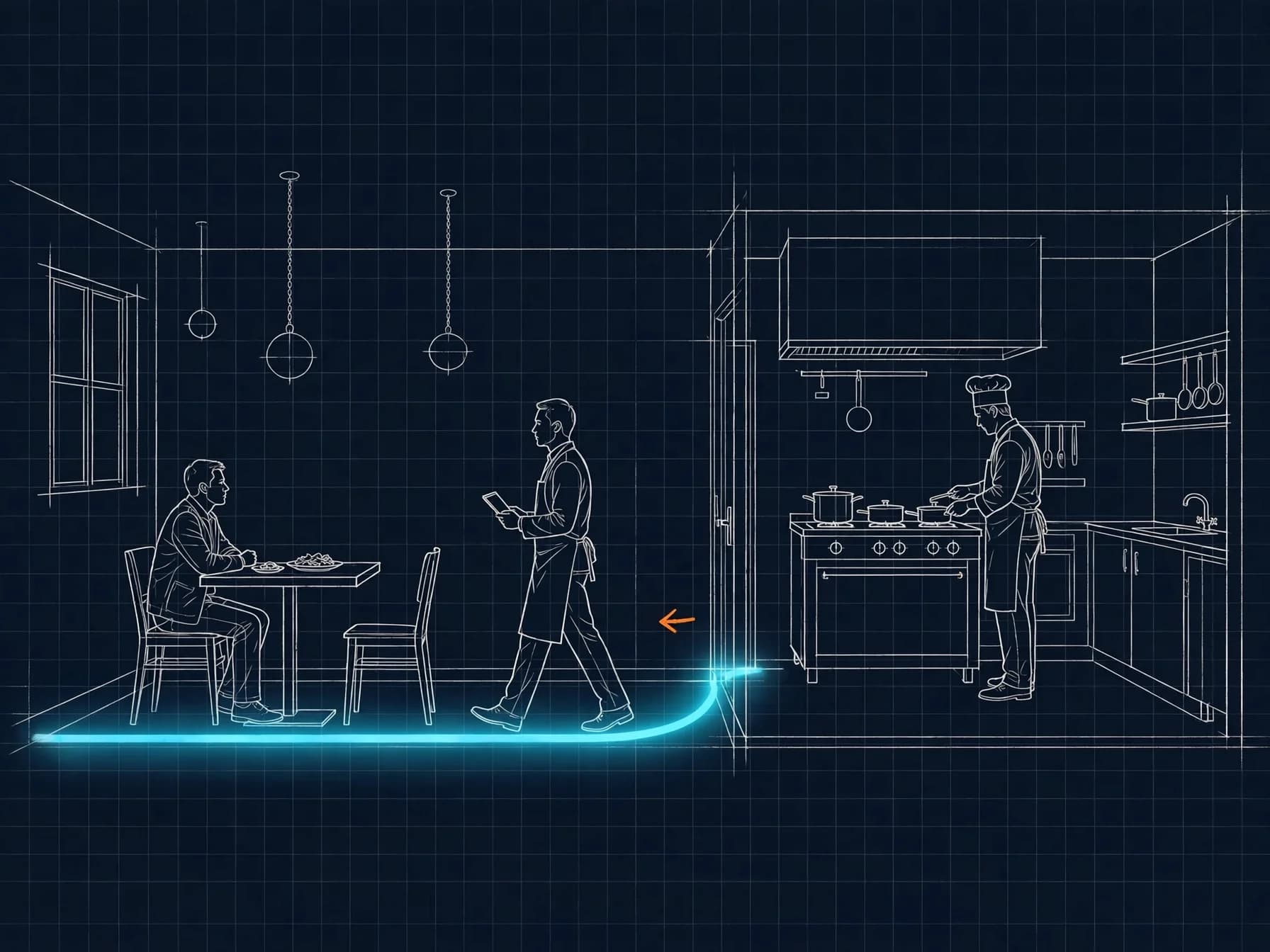
A system is a set of parts that work together to produce a result. A web app is a system, and so is a restaurant. In a restaurant, you are the : you ask for something. The kitchen is the : it does the work. The waiter is the network: it carries your order to the kitchen and brings the dish back. What you ask for is a ; what you receive is a .
Computers use the same pattern. Your browser is a client. It sends a request over a network to a server. The server does some work — perhaps it looks up a product or checks a password — and sends a response back. The client does not need to know how the kitchen is arranged, and the server does not need to know who is asking. They agree on the shape of the message, and that is enough.
This split is useful because each side can change on its own: you can upgrade the kitchen without buying new tables.
A request's journey
Let's follow one . First, your browser builds a request: a short message that says what it wants. The request leaves your device and travels across the network. That travel takes time, even at the speed of light, because the distance is real and the message is forwarded along the way.
When the request reaches the , the server does its work. It might read a file, query a database, or do a calculation. Only then does it build a and send it back. The response travels over the same kind of network and arrives at your browser, which shows the result.
The outward trip and the return trip together are called a , often shortened to RTT. A round trip means “there and back”, not just “there”. When someone quotes a network latency of 100 ms, check whether they mean one way or a full round trip, because the difference doubles the number you will use.
Where the time goes
The time you wait is the sum of three pieces: the time the spends travelling out, the time the spends working, and the time the spends travelling back. As a formula:
Response time = travel there + work + travel back.
Here is an illustrative example, the same one used in the lab. Suppose the network takes 100 ms in each direction and the server takes 20 ms of work. The response time is 100 + 20 + 100 = 220 ms. Of that 220 ms, 200 ms was travel and only 20 ms was actual work.
This is why “the server is slow” is not always the right diagnosis. Make the server twice as fast and you save 10 ms. Halve the network latency instead and you save 100 ms. Before changing anything, find out which part is biggest.
Many clients, one server
A real serves many clients, working on their requests one after another or in parallel. Each carries everything the server needs, so requests are independent: the server does not have to remember what the previous one asked for.
That independence matters. While your request is travelling, the server can work on someone else's request, so the network wait is not wasted server time. A slow network for one user does not slow the server for everyone else.
When a page feels slow, ask where the time went before blaming the server. It might be the trip out, the work, or the trip back. The lab lets you change each piece and watch the total move.